CPD Welcomes Trevor Cuddy!

“Life is short!” – Trevor Cuddy

Meet Trevor Cuddy.

Starting Monday, September 29, 2014, Trevor will take on the role of Director of the CPD Portfolio. His duties will be divided between the Standardized Patient Program and CPD.

Trevor CuddyTrevor brings with him over 20 years of leadership experience in various roles at educational institutions including York University, Concordia, Queen’s and now returns to the University of Toronto.

His education along with his experience has helped form his leadership style: one that is inclusive, collaborative and goal-oriented. He has a Masters Degree in Education from UofT/OISE and a Bachelor of Commerce and Bachelor of Arts degree from Queen’s.

Trevor is looking forward to the variety of the work he will do with the CPD portfolio and getting to know the team. He hopes to bring his education and experience into this environment to make a difference and contribute to its growth and successes.

Beyond working life, Trevor has two well-loved shar-peis, enjoys snowboarding and weekends at the family cottage. His favourite places to visit are Barbados, South Africa, and the Turkish city of Istanbul.

Welcome, Trevor!

He takes his coffee black.

Perspectives in Competency Assessment: Exploring excellence, from theory to practice (February 5, 2015)

Centre for the Evaluation of Health Professionals Educated Abroad (CEHPEA) presents a day-long program features engaging discussions in competency assessment. Exploring theories, challenges and future trends through different lenses for an enriching day of interprofessional learning and development. February 5, 2015.

More information and Registration

Dr. Anna Banerji: From Calcutta to Iqaluit

Written by Tristan Bronca on August 31, 2014

A vocation born on a bridge in India leads Dr. Anna Banerji to the Canadian Arctic

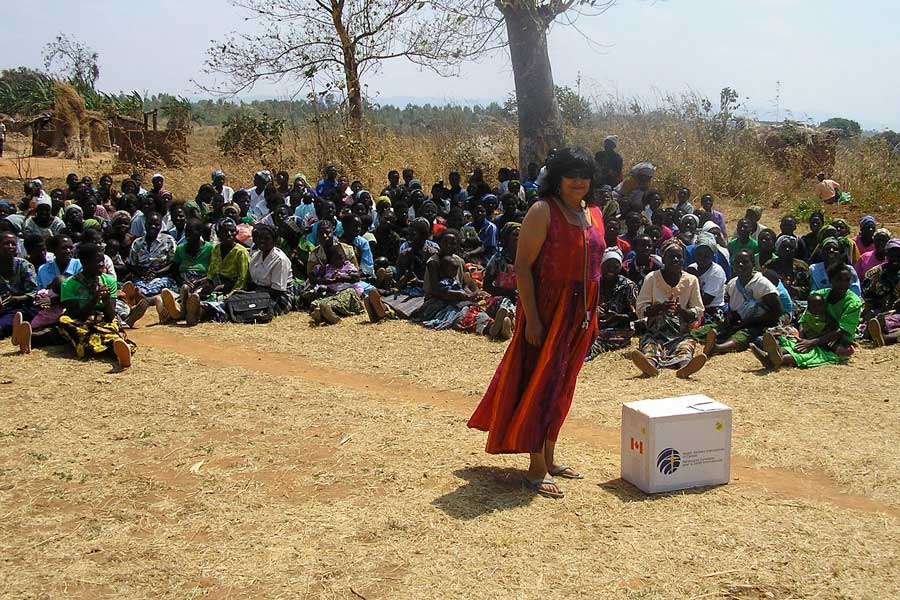
In 2009, word got out that Dr. Banerji would open a small clinic in a village in Malawi and 300 people lined up to meet her. “I saw 200 kids that day in a cement shelter with no running water, electricity or examination table,” she later wrote.

When Dr. Anna Banerji was 11 and visiting Calcutta for the first time, her mother took her across the city’s famous Howrah Bridge. It is one of the busiest bridges in the world and that morning back in the 1976 was no different. The walkways were jammed with pedestrians and the middle lane ways were crowded by goats, cows, trucks, and rickshaws, all of them trying to make their way to or from the Howrah train station at the opposite end.

Within that chaotic scene, she noticed a man on side of the road, nearly naked and bleeding from his head. “He was lying in the gutter and nobody stopped,” she remembered. “All of Calcutta just moved forward.”
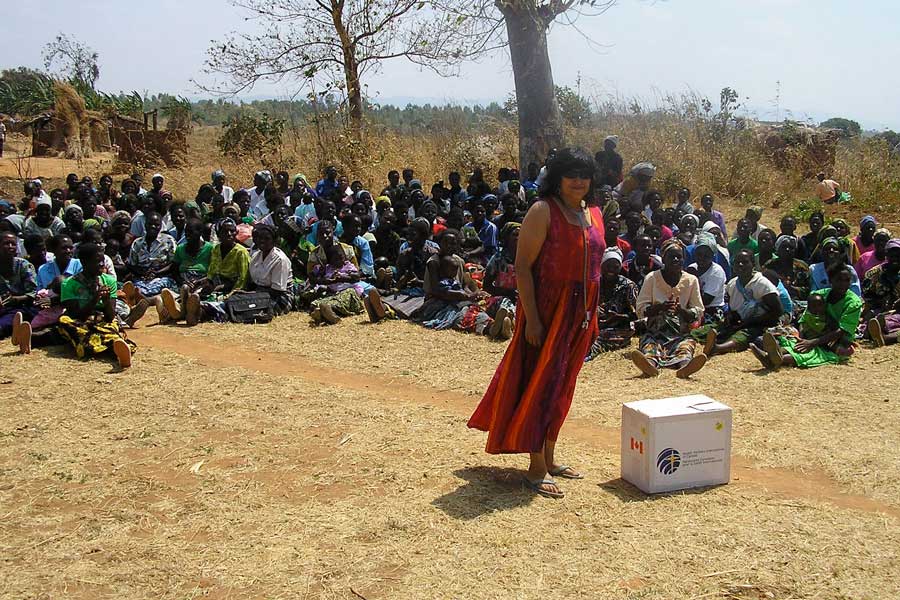
Dr. Banerji openning a small clinic in a village in Malawi - 2009

Dr. Banerji openning a small clinic in a village in Malawi – 2009

It was a moment of almost eerie clear-sightedness that, by her own admission, changed her life. Right then and there, she decided she would become a doctor and devote her life to improving international health.

Today, Dr. Banerji is the Director of Global and Indigenous Health, Continuing Professional Development, at the University of Toronto;; an appointment she juggles with two professorships at the university and eight other appointments at Toronto hospitals. She works primarily with refugee children and, having visited more than 50 countries, became a tropical and infectious disease specialist to optimize her impact in those parts of the world.

Her 27-page CV is scattered with awards (the Order of Ontario and the Diamond Jubilee Medal both in 2012), grants (the Canadian Infectious Disease Society/Bayer Canada) and research that spans from the Arctic to Asia.

But the reason for her acclaimed body of work is also, perhaps, the aspect least recognized by those outside her field: her patients. Dr. Banerji ministers to populations that are among the world’s most vulnerable, disadvantaged and ignored.

In 1995, her work brought her closer to home when she travelled to the Arctic for the first time. She noticed unusually high rates of lower respiratory tract infections (LRTIs) in Inuit children. She began a study later published in the Canadian Medical Association Journal (June 26, 2001) that revealed nearly half the babies born on Baffin Island end up in the hospital with lung infections in their first six months of life. But this wasn’t news to people living there. Soon Nunavut’s Chief Medical Officer of Health (CMOH) recognized her expertise in the area and commissioned further studies.

“She called me saying, ‘We know the rates are high, but why?’” Dr. Banerji said.

The answer might, in part, explain how an internationally minded doctor ended up settling in the Canadian north. A follow-up paper in the Pediatric Infectious Disease Journal (August 2009) showed the factors contributing to these swollen rates were similar to those affecting other vulnerable populations around the world: living in overcrowded conditions, exposure to cigarette smoke and lack of breastfeeding. Dr. Banerji also mentioned that conditions such as dental abscesses, malnutrition and those resulting from physical trauma can be just as common among northern populations as they are among those living in poverty-stricken regions of the globe—problems made worse by language and cultural barriers that inhibit access to care.

In other words, it was clear to Dr. Banerji that these people living on Canadian soil had more in common with patient populations half the world away than they did with their fellow Canadians.

“You know, when we think of global health, we think of Australian Aborigines, but anyone an hour south of here would say the Inuit is an (equally) unique population,” she pointed out, “and they’re in our own backyard.”

Still, despite the “phenomenal numbers” that have come out of the several research papers she’s authored, Dr. Banerji struggled to get many of them published;; evidence, she said, of the systematic neglect faced by Indigenous populations.

In 2009, Dr. Banerji began a study to track almost every birth in northern Quebec, Nunavut and the Northwest Territories over the next year and a half—an unprecedented sample size in that part of the world. In that time, more than 25% of infants in her sample were hospitalized with a lower respiratory tract infection. A separate paper on the same study published in the International Journal of Circumpolar Health (August 2013) revealed the cost of each hospitalization in Nunavut averaged $55,265 after transportation, evacuation and inpatient costs. A vaccine called palivizumab has been shown to prevent RSV admissions but is currently administered only to premature babies or those with chronic lung conditions. But, as she demonstrated in another article published in the Pediatric Infectious Disease Journal (also in August 2009), administering the drug to more infants in certain communities would reduce hospital admissions and the massive expenditures on treatment.
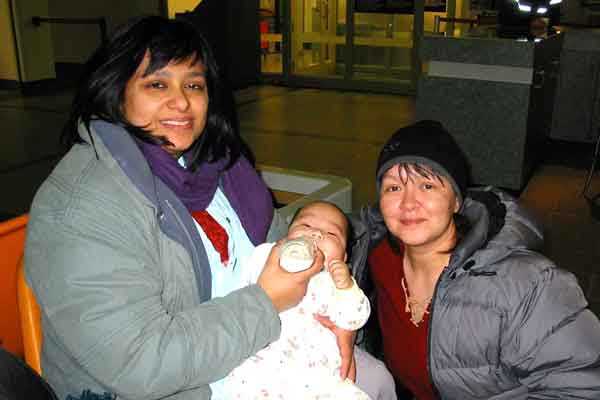
Pictured with her adopted son, Nathan, and foster mother, Monica, in 2004.

Pictured with her adopted son, Nathan, and foster mother, Monica, in 2004.

But, during a recent submission, one of the editors (of a journal The Medical Post has agreed not to name) “basically said there wasn’t enough interest in this,” she said. “He didn’t think the impact factor was high enough.” She referred the reluctant editor to one of her 2009 “risk factor” article in the Pediatric Infectious Disease Journal which, perhaps not coincidentally, had also been rejected by the same journal. It had been cited 48 times, prompted mainstream media coverage and, along with the companion paper on the cost of hospitalizations, led to changes in the Canadian pediatric guidelines. “That’s a high impact paper,” she said.

She has faced other difficulties too. Apart from a very public spat with the CMOH in one of the territories, there are a number of stumbling blocks that the public doesn’t see splashed across the media. The first is cost. The price of a return trip ticket to parts of the Arctic can be as expensive as flying to Europe. That, coupled with shortage of manpower, means studies can cost hundreds of thousands of dollars and researchers often have trouble leveraging the health-care workers in the region because many facilities are already understaffed.
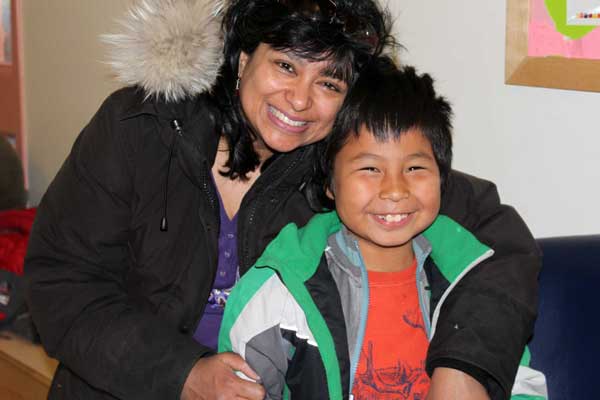
Dr. Banerji and Nathan during their trip to Iqaluit in 2013.

Dr. Banerji and Nathan during their trip to Iqaluit in 2013.

The populations also tend to be small and difficult to access, meaning researchers don’t get the same enrolment as you do in other parts of the world;; problems that are further exacerbated by the cultural mistrust that lingers after centuries of trauma and ill-will.

In spite of this, Dr. Banerji has managed to forge a number of strong connections to the people she’s dedicated to helping, some of which have even bubbled over into her private life. Perhaps the most obvious example of this is her son, Nathan.

In the early years working in the Arctic, ” I would review charts of LRTI admissions and occasionally I would come across a child who was found in the snow in their diapers while the parents were out drinking,” she began. “It broke my heart. So I went to an Inuit elder named Towaga and I said one of these days I want to adopt an Inuit child.”

Nine years later, on December 28, 2004. Dr. Banerji was driving her daughter to a play date just days before she was scheduled to fly to Indonesia to assist with the Boxing Day tsunami rescue effort. A resident of hers named Dr. Barry Pakes, who was doing a locum on Baffin Island, called to say her name had come up at rounds that morning. A new mother had approached Towaga to give her baby up for adoption. When Towaga mentioned how Dr. Anna always wanted to adopt an Inuit child, Dr. Pakes piped up. “Dr. Anna Banerji?” he would later remember. He had her number on speed dial. “I nearly crashed my car when they called,” she remembered.

While Dr. Banerji was excited by the news, the adoption fell through but the call had put her in touch with the local director of adoptions. Three weeks later, she flew up north to pick up a six-month-old baby that had been stuck in the foster system.

“I didn’t know the age or if it was a boy or a girl,” she chuckled. She brought the little boy home to a somewhat confused four-year-old sister—she would later tell her class that her “mummy bought a baby at the airport,” Dr. Banerji said—and a very obviously unprepared household. “We were renovating,” she said, “I had my bathroom sink in the middle of the living room.”

Now the baby she first saw in a blue snowsuit at Iqaluit airport, Nathan, is nine-years-old and Dr. Banerji has something more than a professional interest in the Arctic. Every two years, on one of her trips to Nunavut, he goes with her. “I want him to know about his heritage,” she said.

Right now, Dr. Banerji said there are huge discrepancies between Indigenous health care and care in other parts of the country. She said those two shortcomings play a huge role in this disparity but, if addressed they could knock down at least some of the barriers to equitable care.

“You know, two days is not a lot to learn about the culture,” she said. “but it’s a start.”

Dedication, Passion & Longevity: 25 Years of Service

Arriving at any milestone is an achievement of dedication, passion and longevity.

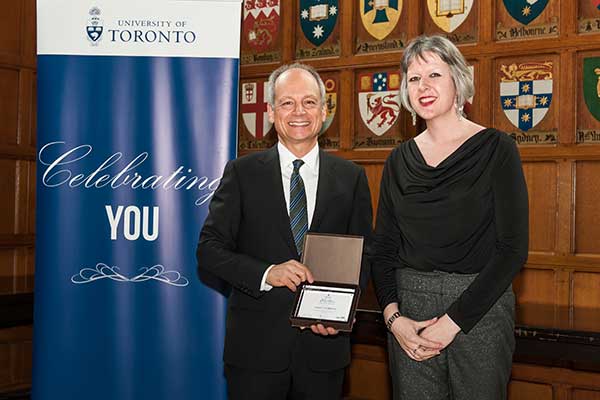
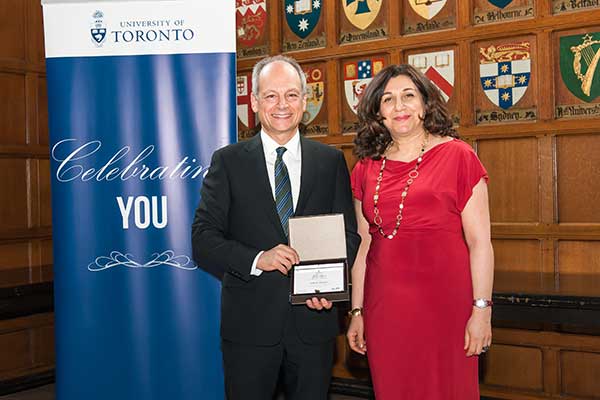
On May 7, 2014, the University of Toronto celebrated Long Service Awards of employees who have worked for 25, 35, and 40 years at the school. Two of our colleagues celebrated 25 years each of service at the University: Vashty Hawkins and Karma Farah. The event was held at the Great Hall, Hart House. The awards were presented by Meric Gertler, President, University of Toronto.

Vashty Hawkins

Vashty Hawkins, Assistant to the Vice Dean at CPD, started her career at OISE and moved onto Continuing Professional Development in 2004. We asked Vashty what it meant to her to be a part of the University of Toronto culture. She said, “Being part of an institution with a long and venerable history of academic excellence in this city, country, and internationally.” The biggest highlight of her career to date was getting to work on the University of Toronto Oncology Continuing Education program with the late Dr. Robert Buckman.

Karma-Farah

Karma Farah started off as an Office Administrator in Biochemistry. She is now the Accreditation Coordinator at CPD and says about her experience: “Throughout 25 years of working at the university, I have had the wonderful opportunity to meet and interact with so many faculty and staff. The blend of U of T’s academic excellence with its culturally diverse population of students, faculty, and staff make it an exceptional community to work in!” Karma goes on to share: “It is highly rewarding to be part of CPD and play a role in the accreditation of so many continuing education events, which are a venue for educators, researchers, students, and all health professionals to keep evolving in their specialities and their learning. I am privileged to work with programs that hold the promise of better health outcomes!”

Congratulations to Vashty and Karma for 25 years of excellence and dedication to helping make University of Toronto a leader in education in Canada and achieving global recognition.

CPD Announces 2012-2013 CE Award Winners

CE-Awards-Image-2013-2014The Continuing Education Awards Adjudication Committee has selected the following nominees as award recipients for this past academic year (2012-2013):
Colin R. Woolf Award for Excellence in Course Coordination

David Jaffray, Pamela Catton and Nicole Harnett (Department of Radiation Oncology) for developing a broad interprofessional curriculum in radiation oncology (Princess Margaret Hospital Accelerated Education Program) that looks at impact on practice as an outcome.

Colin R. Woolf Award for Long-Term Contributions to Continuing Education

Paula Ravitz (Department of Psychiatry) for the breadth and depth of her contributions to CPD in a relatively short period of time: Leadership, scholarship, research, publications and program development.

Colin R. Woolf Award for Teaching Excellence

Miriam Weinstein (Department of Paediatrics) for her glowing teaching evaluations from multiple course participants over several years.

David Fear Fellowship

Douglas Wooster (Department of Surgery, Division of Vascular Surgery) to develop an electronic vascular ultrasound curriculum.

Ivan Silver Innovation Award

Joel Sadavoy, Virginia Wesson and LJ Nelles (Department of Psychiatry) for their train-the-trainer “The Reitman Centre CARERS” program designed to educate family members how to care for their relative Alzheimer’s disease with the ultimate goal to allow the Alzheimer’s patient to remain longer in a home environment before becoming institutionalized.

Interprofessional Team Continuing Education Award

Michael Pollanen (Department of Pathology and Laboratory Medicine) for the interdisciplinary interprofessional program for coroners, lawyers and pathologists as well as technologists on suicide.

CPD congratulates all the Continuing Education Award winners on their recognized excellence in education and teaching! They will be presented with their CE Awards at the 2014 Faculty of Medicine Education Achievement Celebration taking place on Tuesday, May 13, 2014 from 4:30pm-7:00pm at Hart House (The Great Hall).

As a follow up to the celebration on May 13, CPD will feature more in-depth profiles of some of the award-winners in our Blog. Stay tuned for the first feature in late May.

How a Walk in the Woods is Changing Nursing CPD

On February 7th and 8th, Dr. Simon Kitto and Rachel Grant facilitated a “Walk in the Woods” workshop with the American Nurses Credentialing Center (ANCC) to move continuing nursing education from a time-based to a competence-based approach. A competence-based approach would shift the focus to validating the functional capability of nurses rather than the amount of time spent on continuing education (Hodges, 2010).

“One of the best working meetings I’ve ever had the privilege of attending.”

By the end of the intensive two-day workshop, the Task Force developed a new conceptual model for continuing nursing education, a pilot research study, and formed several working groups.

The American Nurses Credentialing Center

The ANCC is a subsidiary of the American Nurses Association that promotes excellence in nursing and patient care through the credentialing of nurses and accreditation of organizations offering continuing nursing education (ANCC, 2014).

“The facilitators were very instrumental in moving our discussion forward to producing a tangible outcome.”

Task force members present included ANCC staff (Dr. Kathy Chappell, Mary Golway, Sibyl Lavin, Diane Thompkins) and commissioners (Dr. Pam Dickerson, Montana Nurses Association; Dr. Lyn DeSilets, Villanova University; Dr. Mary Anne Celenza, Community Colleges of Philadelphia; Dr. Sharon Decker, Texas Tech University; and Dr. Jobeth Pilcher, Baylor Healthcare System).

The ‘Walk in the Woods’ Method

The Walk in the Woods is a method for multidimensional problem solving that is geared to reaching a deal with the necessary buy-in and support. Key components include:

  1. Identification of self-perceived needs;
  2. Agreement on key issues
  3. Developing options on getting these interests met and prioritized; 4.Reaching agreement on options and developing a detailed plan.

“The Walk in the Woods will be good reading for any future nursing endeavors for change.”

Marcus, Dorn & McNulty (2012) describe how the name originates from the Cold War nuclear arms reduction negotiators. Two negotiators literally went for a walk in the woods after reaching an impasse in the negotiations. During their walk, they developed a genuine understanding of the interests of each other’s country and were able to reach an agreement. Although this agreement was ultimate rejected by the United States and Soviet Union, their meeting has come to symbolize the advantages of informal interpersonal bargaining and interest-based negotiation.

Past Walk in the Wood Workshops

This is the second Walk in the Woods workshop that the CPD Research Programme has facilitated. In June 2013 Simon and Dr. Stella Ng (University of Toronto) co-facilitated a Walk in the Woods for the Council of Ontario Faculties of Medicine CPD consortium, with Rachel as the structural designer.

“We now have a great start to use in moving forward to next steps.”

References

  • ANCC (2014). About ANCC. Retrieved from: http://www.nursecredentialing.org/FunctionalCategory/AboutANCC
  • Hodges, B. D. (2010). A tea-steeping or i-Doc model for medical education? Academic Medicine, 85(9), S34-S44.
  • Marcus, L. J., Dorn, B. C., McNulty, E. J. (2012). The walk in the woods: A step- by-step method for facilitating interest-based negotiation and conflict resolution. Negotiation Journal (July), 337-349.

CACME Report on CPD Available Now

In the spring of 2013, the Committee on Accreditation of Continuing Medical Education (CACME) conducted a survey visit of Continuing Professional Development (CPD). The Committee identified the following strengths at CPD:

  • The support provided by the dean.
  • Highly educated and committed professional staff.
  • Clear strategic plan with well-defined milestones monitored at six month intervals.
  • Continuous investment and re-investments in the operation.
  • Well-developed policies and procedures that are transparent.
  • Well established and resourced program of research and innovation.

The full CACME report is now available online. To read the report, please click here.

Submitted post: New and Emerging Academic Leaders Program – Accepting Applications

The goal of the New and Emerging Academic Leaders (NEAL) program is to foster a productive, visionary and collaborative academic leader in the Academic Health Science System. Participants will become members of a community of leaders who have the mindsets and capabilities to successfully run their division, research, education or other academic unit and help their faculty be successful.

We are inviting applications from individuals, both nationally and internationally, with faculty appointments in Faculties of Medicine or Health Sciences. Applicants must have been in a faculty position for at least 3 years and have academic leadership roles and/or responsibilities. Such leaders, with or without formal institutional roles, are engaged in the academic mission of research, education or program development.

If you or someone in your organization may benefit from this program, please review our program and application information.

Our deadline for applications is April 22, 2014 (for early bird tuition rate) and June 2, 2014 (final deadline).

This post was submitted by the Centre for Faculty Development at St. Michael’s Hospital, Faculty of Medicine, University of Toronto.

New Year – New Name

Continuing Professional Development

Continuing Education and Professional Development (CEPD) has been undergoing some important changes over the last year, all of which are reflected in our new name and signature.  Going forward CEPD will now be called CPD – Continuing Professional Development. The signature also clearly identifies us as part of the Faculty of Medicine at the University of Toronto.

“We’re looking forward to a fresh start in the new year with this new name” says CPD’s Vice Dean, Dimitri Anastakis.

This name has been in development for a while now, but with the new year comes an opportunity to celebrate change, so with the start of 2014 we will officially be known, on all our platforms, as CPD. The four main reasons for this new name are: to build upon the University of Toronto’s reputation, to signify the changes in our portfolio, to bring greater emphasis to our work in ‘professional development’, and to be consistent with other universities globally. We hope you will share in this celebration with us and look forward to a new year full of advancement as Continuing Professional Development.

Dr. Banerji Presents to Visiting Physicians from China

Last month, CPD’s Director of Global and Indigenous Health, Dr. Anna Banerji made a presentation to a group of twenty visiting physicians from China. Here she shares her experience of meeting with these delegates and sharing with them her background working in the Arctic and with Canada’s Indigenous people.

AB1

“On Oct 30th approximately 20 doctors from across China came to meet with faculty at the University of Toronto. These physicians are directors of travel medicine clinics in China, and many of them were infectious and tropical disease specialists that provide services through International Association for Medical Assistance to Travellers (IAMAT). The mission of the group was to learn about health care and health care management in Canada.

One of the physicians they met was me. I initially spoke about my research in the Canadian Arctic and soon it became clear to the Chinese physicians that Canada also had issues about health care access and many of the visitors were surprised that in a resource rich country, such as Canada, many Indigenous people do not have access to clean water and healthy foods. They were also surprised that the life expectancy of the Inuit was 64.5, which is much lower than that of China. I also spoke about my work with refugees in my pediatric immigrant/refugee health clinic and the North American Refugee Health Conference, which I chair. I also spoke about the recent cuts to refugee health by the Federal government and how in Canada I had the right to peacefully protest publicly without the fear of reprisal. I then talked about some of my international work with the Canadian Red Cross in Haiti after the earthquake and my recent trip to Ethiopia. Near the end of the talk, it appears that the world was a bit smaller and that the Doctors from China realized that there was more in common with Canada than what they had originally thought.”

Dr. Banerji is the chair and course director for the North American Refugee Health Conference which will be held again in June 2015.

AB9